
 By Shweta Goyal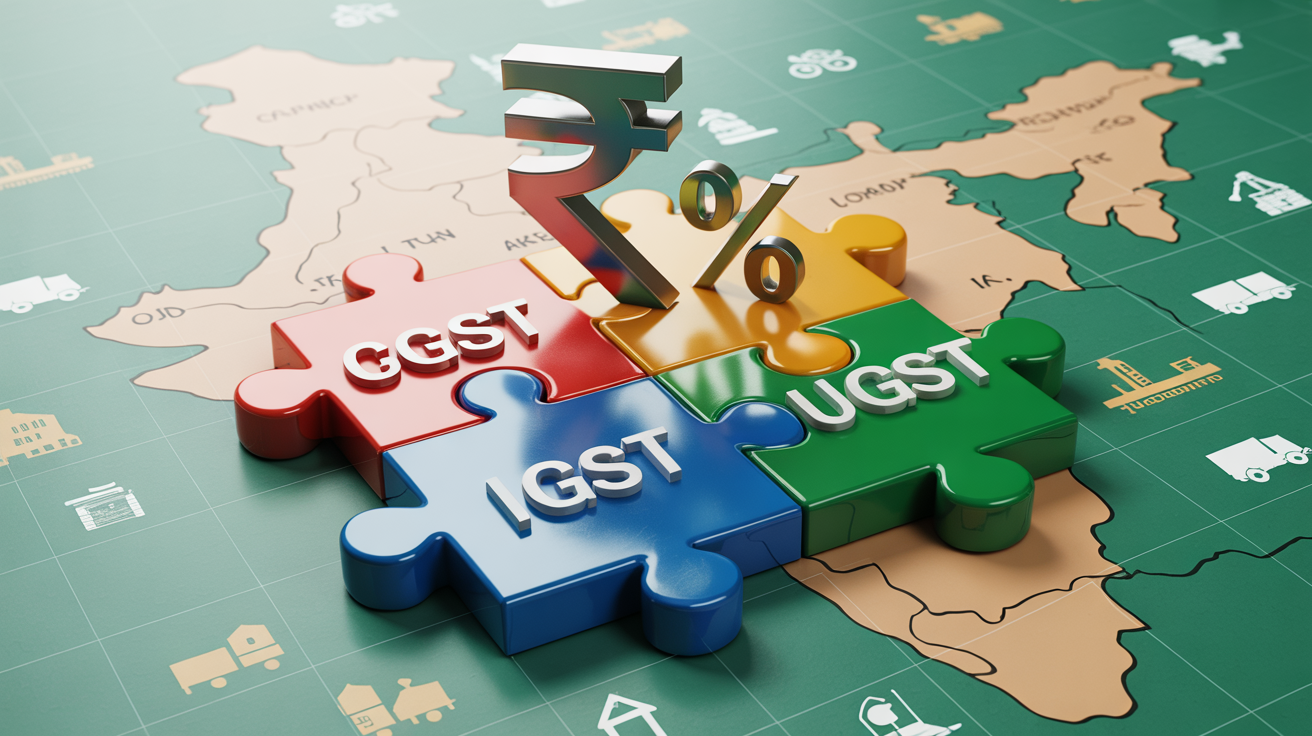
🧾 Understanding CGST, SGST, IGST & UTGST
Since its rollout on 1st July 2017, the Goods and Services Tax (GST) has revolutionized India’s indirect taxation system. One of the key features of GST is that it is a dual model, designed to be levied by both the Centre and the States. This leads us to four types of GST: CGST, SGST, IGST, and UTGST.
Understanding these types is crucial for any business owner, accountant, or tax professional. In this blog, we’ll explain each type in detail and provide examples to clarify how they are applied.
🧾 What Are the Types of GST in India?
There are four components of GST:
- CGST – Central Goods and Services Tax
- SGST – State Goods and Services Tax
- IGST – Integrated Goods and Services Tax
- UTGST – Union Territory Goods and Services Tax
Let’s break them down:
- CGST – Central Goods and Services Tax
📌 What is CGST?
Central Goods and Services Tax (CGST) is one of the key components of the Goods and Services Tax system in India. It is levied by the Central Government on the intra-state supply of goods and services—that is, when the buyer and the seller are located in the same state or Union Territory.
CGST is governed by the Central Goods and Services Tax Act, 2017 and is collected along with SGST (or UTGST in case of Union Territories).
🔍 Why is CGST Important?
CGST ensures that the Central Government gets its fair share of tax revenue on intra-state transactions. It replaces multiple earlier taxes like:
- Central Excise Duty
- Service Tax
- Additional Customs Duty (CVD)
- Special Additional Duty of Customs (SAD)
💰 How is CGST Charged?
When a sale happens within a state (intra-state), the GST is split equally between:
- CGST (Central share)
- SGST (State share)
⚠️ Common Compliance Issues in CGST
- Charging CGST on an inter-state transaction (should be IGST instead)
- Incorrect input tax credit utilization (using CGST ITC for SGST liabilities)
- Non-filing or delayed filing of GSTR-1 and GSTR-3B returns
- SGST – State Goods and Services Tax
📌 What is SGST?
State Goods and Services Tax (SGST) is the portion of the Goods and Services Tax collected by the State Government on intra-state transactions, i.e., when the seller and buyer are located within the same state.
SGST is governed by the respective State SGST Acts, which are aligned with the framework provided by the GST Council, ensuring uniformity in law across all Indian states.
🔍 Why is SGST Important?
SGST helps ensure that state governments receive revenue from intra-state supplies. It replaces several pre-GST taxes that were levied by the states, such as:
- Value Added Tax (VAT)
- Entry Tax
- Luxury Tax
- Entertainment Tax (not covered under GST now in some cases)
With SGST in place, tax cascading has reduced, and the taxation system has become more transparent and efficient.
💰 How is SGST Charged?
Whenever a taxable transaction happens within a state, the GST is split equally between:
- CGST – goes to the Central Government
- SGST – goes to the State Government
- IGST – Integrated Goods and Services Tax
📌 What is IGST?
Integrated Goods and Services Tax (IGST) is levied by the Central Government on inter-state supplies of goods and services and on imports and exports. It plays a critical role in ensuring that the destination state gets its due share of tax when a transaction crosses state borders.
IGST is governed by the Integrated Goods and Services Tax Act, 2017 and is a unifying component in the GST structure, ensuring seamless movement of goods across state boundaries without multiple tax layers.
🔍 Why is IGST Important?
IGST ensures that tax is collected on inter-state transactions in a centralized and transparent manner and later distributed to the destination state (i.e., where the goods or services are consumed).
It replaces older inter-state taxes like:
- Central Sales Tax (CST)
- Import Duties (partially through IGST on imports)
IGST also resolves the credit chain issue that existed in the pre-GST era during inter-state trade.
💰 How is IGST Charged?
In contrast to intra-state sales (where CGST and SGST are charged), inter-state supplies attract a single IGST charge that is collected by the Centre.
⚠️ Common IGST Mistakes
- Misclassifying intra-state sales as inter-state and charging IGST incorrectly
- Forgetting to claim ITC of IGST on imports
- Filing incorrect GSTR-1 or GSTR-3B leading to mismatches and refund delays
- UTGST – Union Territory Goods and Services Tax
📌 What is UTGST?
Union Territory Goods and Services Tax (UTGST) is levied by the Union Territory Government, in conjunction with CGST, on intra-UT (within Union Territory) supplies of goods and services.
It is applicable only in Union Territories that do not have their own legislatures, and it functions similarly to SGST. While SGST is applicable in states, UTGST applies in select Union Territories, ensuring a unified and equitable GST structure across the country.
📍 Where is UTGST Applicable?
UTGST applies to the following Union Territories:
- Andaman and Nicobar Islands
- Lakshadweep
- Dadra and Nagar Haveli and Daman and Diu
- Chandigarh
- Ladakh
For Union Territories with legislatures like Delhi, Jammu & Kashmir, and Puducherry, SGST applies instead of UTGST.
💰 How is UTGST Charged?
When a supply of goods or services takes place within a Union Territory, the GST is divided between:
- CGST – levied by the Central Government
- UTGST – levied by the Union Territory Government
🧩 Summary Table: GST Types at a Glance
| Type | Full Form | Levied By | Applicable On | Example |
| CGST | Central Goods & Services Tax | Central Government | Within State/UT | Sale within Maharashtra |
| SGST | State Goods & Services Tax | State Government | Within State | Sale within Karnataka |
| IGST | Integrated Goods & Services Tax | Central Government | Between States/Imports | Sale from Delhi to Kerala |
| UTGST | Union Territory Goods & Services Tax | Union Territory Govt | Within UTs | Sale within Chandigarh |
Key Points to Remember
- For intra-state/UT transactions → CGST + SGST/UTGST
- For inter-state or import/export → IGST
- Businesses must understand the place of supply rules to apply the correct type of GST.
📝 Final Thoughts
Understanding the four types of GST is essential for compliance and correct invoicing. Misapplying GST types can lead to penalties, interest, and audit issues. With digital filings and audits becoming more common, staying GST-accurate is not just good practice—it’s a legal necessity.
If you’re a business owner or tax professional, make sure your accounting software or billing system is correctly configured to distinguish between CGST, SGST, IGST, and UTGST.