
 By Shweta Goyal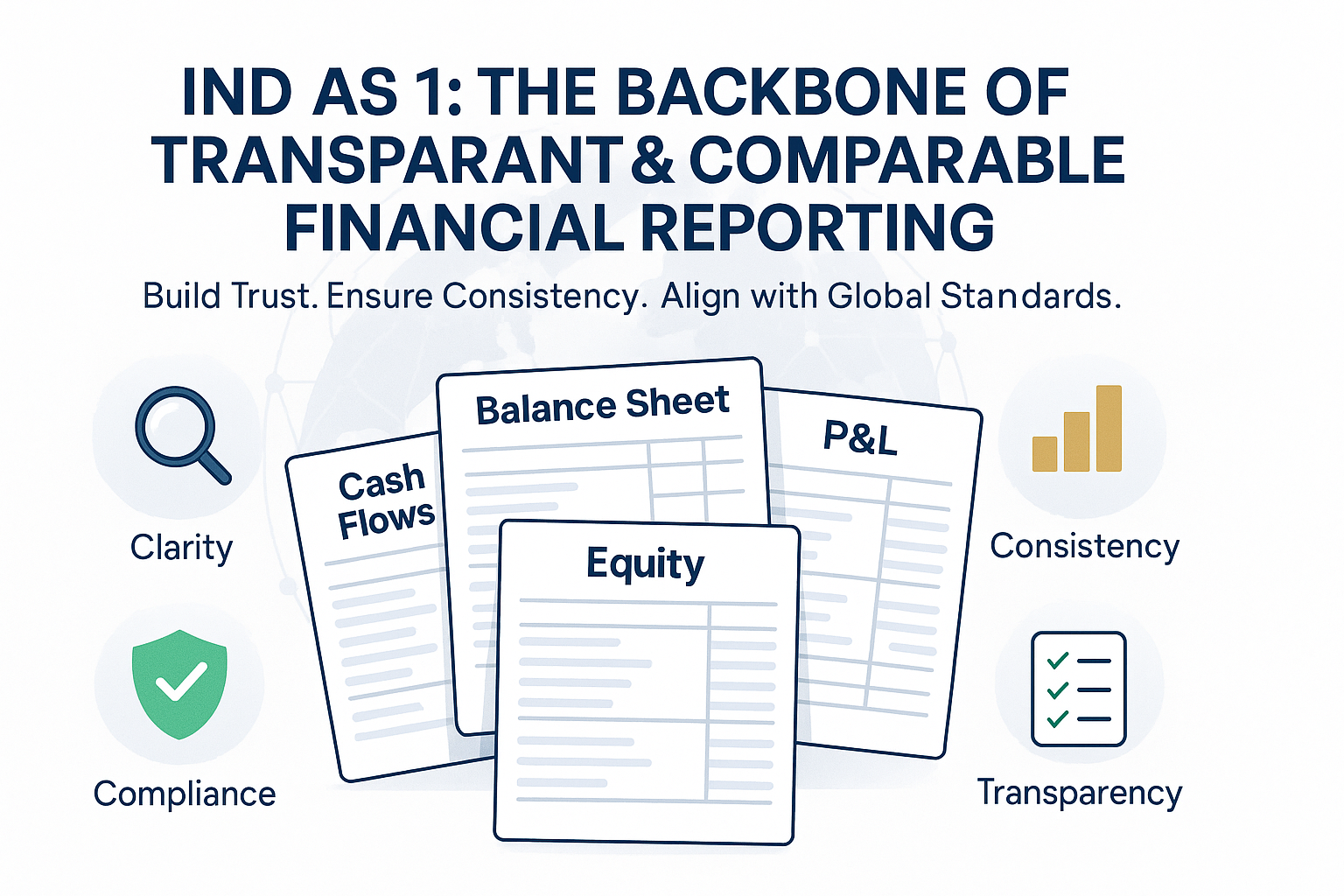
Ind AS 1: Presentation of Financial Statements
Understand the backbone of financial reporting under Indian Accounting Standards (Ind AS).
🔍 What is Ind AS 1?
Ind AS 1 lays down the fundamental principles for presenting general-purpose financial statements to ensure comparability with the entity’s previous periods and with financial statements of other entities. It applies to all entities that prepare financial statements under Ind AS.
It does not prescribe which items to recognize, how to measure them, or which disclosures are specifically required for certain transactions (these are dealt with in other Ind ASs). Instead, it focuses on how financial information should be presented and disclosed.
🧾 Objective of Ind AS 1
To ensure:
- Comparability across time periods and with other companies.
- Clear, transparent presentation of financial performance and position.
- Uniform financial reporting that reflects a true and fair view.
🏗️ Key Components Required by Ind AS 1
A complete set of financial statements should include:
- Balance Sheet (Statement of Financial Position)
- Statement of Profit and Loss (including Other Comprehensive Income)
- Statement of Changes in Equity (SOCE)
- Statement of Cash Flows (as per Ind AS 7)
- Notes to Accounts, including summary of significant accounting policies
- Comparative Information for the preceding period
- Third Balance Sheet, when applicable (explained below)
🔁 Accrual Basis & Going Concern
- Ind AS 1 mandates that financial statements must be prepared using the accrual basis of accounting.
- The entity must assess its ability to continue as a going concern; if this assumption is no longer valid, disclosures and a different basis of accounting are required.
🏗️ Structure and Content Guidelines under Ind AS 1
Ind AS 1 provides a clear framework on how financial statements should be structured and what minimum content they must include. The goal is to promote consistency, comparability, and transparency in financial reporting.
📘 Complete Set of Financial Statements Includes:
- Balance Sheet (Statement of Financial Position)
- Statement of Profit and Loss, including Other Comprehensive Income (OCI)
- Statement of Changes in Equity (SOCE)
- Statement of Cash Flows (as per Ind AS 7)
- Notes to Financial Statements, including significant accounting policies
- Comparative Information for the previous period
- Third Balance Sheet, if required under specific circumstances
🔹 1. Balance Sheet (Statement of Financial Position)
Purpose:
Shows the financial position (assets, liabilities, and equity) of the entity at the end of the reporting period.
Key Guidelines:
- Assets and liabilities should be classified into current and non-current.
- Line items should include (at minimum):
- Property, Plant, and Equipment (PPE)
- Intangible Assets
- Financial Assets
- Inventories
- Trade Receivables and Payables
- Provisions
- Deferred Tax Assets/Liabilities
- Equity Share Capital and Other Equity
🔍 Example:
Non-current assets and current liabilities should be shown distinctly to help assess liquidity and solvency.
🔹 2. Statement of Profit and Loss (Including OCI)
Purpose:
Reports the entity’s financial performance over the reporting period.
Key Guidelines:
- Must include:
- Revenue from operations
- Other income
- Cost of goods sold or services rendered
- Employee benefits
- Depreciation and amortization
- Finance costs
- Tax expenses
- Profit or loss for the period
- Other Comprehensive Income (OCI) must be shown separately and classified into:
- Items that will be reclassified to P&L (e.g., foreign currency gains)
- Items that will not be reclassified (e.g., revaluation surplus)
🔍 Example:
OCI ensures that unrealized gains/losses are disclosed clearly and not mixed with regular P&L items.
🔹 3. Statement of Changes in Equity (SOCE)
Purpose:
Shows the movements in equity during the period.
Key Guidelines:
- Must present:
- Total comprehensive income
- Transactions with owners (dividends, issue of shares)
- Reconciliations of opening and closing balances for each component of equity (e.g., share capital, retained earnings, reserves)
🔍 Example:
If ₹10 lakh was retained from profit and ₹5 lakh dividend was paid, this must be reflected in SOCE.
🔹 4. Statement of Cash Flows (as per Ind AS 7)
Purpose:
Shows cash inflows and outflows during the period, categorized into:
- Operating Activities
- Investing Activities
- Financing Activities
🔍 Example:
Helps assess how the entity generates and uses its cash—critical for investors and lenders.
🔹 5. Notes to Accounts
Purpose:
Provides explanatory information and disclosures necessary to understand the financial statements.
Key Contents:
- Significant accounting policies
- Judgments and estimates
- Breakdown of line items (e.g., PPE schedule, provision details)
- Related party transactions
- Contingent liabilities
- Segment reporting (if applicable)
🔍 Example:
Explains accounting policy for revenue recognition and provides breakup of “Other Expenses.”
🔹 6. Comparative Information
Entities must present:
- Figures for the preceding reporting period
- Narrative and descriptive information, where relevant
🔍 Example:
2024–25 statements must include 2023–24 comparatives for each line item and note.
🔹 7. Third Balance Sheet (Opening Statement of Financial Position)
Required only when:
- Retrospective application of a new accounting policy
- Restatement of prior period amounts
- Reclassification of items
In such cases, three balance sheets are needed:
- End of current period
- End of previous period
- Beginning of previous period
🔍 Example:
If accounting policy is retrospectively changed in FY 2024–25 affecting 1 April 2023 opening balances, a third balance sheet must be shown for 1 April 2023.
✅ Summary Table: Structure & Content
| Component | Purpose | Key Contents |
|---|---|---|
| Balance Sheet | Shows financial position | Assets, liabilities, equity, current/non-current classification |
| Statement of Profit and Loss | Shows performance over period | Revenues, expenses, tax, profit/loss, OCI |
| SOCE | Tracks changes in equity | Profit retained, dividends, reserves, equity issue |
| Cash Flow Statement | Tracks cash movements | Cash flows from operating, investing, and financing activities |
| Notes to Accounts | Provides detailed explanations | Accounting policies, assumptions, breakdowns, related party info |
| Comparative Information | Ensures comparability | Prior period figures next to current figures |
| Third Balance Sheet | Reflects retrospective changes | Required when opening balances are affected by restatements or policy changes |
Ind AS 1 vs. U.S. GAAP
| Aspect | Ind AS 1 (IFRS-converged) | U.S. GAAP |
|---|---|---|
| Framework Structure | One comprehensive standard (Ind AS 1) governs overall presentation | No single standard — guidance spread across multiple ASCs Following- ASC 205 – Presentation of Financial Statements ASC 210 – Balance Sheet ASC 225 – Income Statement ASC 230 – Statement of Cash Flows ASC 235 – Notes to Financial Statements |
| Financial Statement Components | 1. Balance Sheet 2. Statement of P&L and OCI 3. SOCE 4. Cash Flow 5. Notes | 1. Balance Sheet 2. Income Statement 3. Cash Flow Statement 4. Equity Reconciliation (sometimes) 5. Notes |
| Other Comprehensive Income (OCI) | Required as part of a single statement or two-statement approach | Also required, typically presented as a separate component of equity |
| Statement of Changes in Equity | Mandatory and detailed (SOCE) | Not always required in full detail—only significant changes disclosed |
| Classification of Expenses | Allowed by function or nature | Primarily by function (e.g., COGS, SG&A); nature is rare |
| Comparative Financials | Mandatory for at least one prior period | Not mandatory unless required by SEC or other regulators |
| Third Balance Sheet | Required in case of retrospective changes/restatement | Not typically required under U.S. GAAP |
| Current/Non-Current Classification | Required for assets and liabilities | Also required, but strict criteria may vary |
| Subtotals & Headings | Encouraged with flexibility, based on materiality and relevance | More prescriptive formats under specific SEC/industry rules |
| Disclosures of Judgments/Estimates | Required in notes | Required, but less emphasis on judgments than in IFRS/Ind AS |
| Terminology Differences | “Statement of Financial Position”, “Profit and Loss”, “Equity” | “Balance Sheet”, “Income Statement”, “Stockholders’ Equity” |
Key Presentation Principles under Ind AS 1 –
When preparing financial statements under Ind AS 1, entities must adhere to certain core presentation principles that ensure clarity, transparency, and consistency. These principles help users of financial statements—investors, lenders, regulators, and analysts—understand and compare financial information meaningfully.
1️⃣ Materiality
🔹 Meaning:
Only information that is material to the financial statements should be presented separately. An item is considered material if its omission or misstatement could influence the economic decisions of users based on those financial statements.
🔍 Example:
A ₹5,000 petty cash balance may not be shown separately in a large company’s balance sheet with ₹500 crore in total assets—it would be aggregated under “Cash and Cash Equivalents.”
🛑 Implication:
Avoid cluttering the financials with immaterial details. Focus only on what matters for decision-making.
2️⃣ Aggregation
🔹 Meaning:
Similar nature or function items must be grouped together and presented as a single line item, unless their separate presentation is necessary for understanding.
🔍 Example:
All office furniture, fixtures, and equipment can be aggregated as “Property, Plant & Equipment.” However, if goodwill is significant, it must be shown separately from other intangibles.
🛑 Implication:
Ensure that dissimilar items are not inappropriately combined, which could mislead users.
3️⃣ Comparative Information
🔹 Meaning:
Entities must disclose comparative figures for all amounts presented in the current period’s financial statements. This allows users to assess trends and make year-over-year comparisons.
🔍 Example:
If the company is presenting financials for the year ending 31 March 2025, it must also present figures for 31 March 2024 as comparatives.
🛑 Exception:
If a standard requires retrospective application (e.g., change in accounting policy), a third balance sheet at the beginning of the earliest period affected may be required.
4️⃣ Consistency of Presentation
🔹 Meaning:
The presentation and classification of items in the financial statements should be consistent from one period to another unless:
- A change is required by another Ind AS, or
- A more relevant presentation or classification is adopted.
🔍 Example:
If revenue was classified by product line last year, the same approach should be used this year—unless a business restructuring demands a change.
🛑 Implication:
Consistency improves comparability. Any changes in presentation must be disclosed along with reasons.
Key Presentation Principles under Ind AS 1 – with Summary Table
| Principle | Explanation | Example / Implication |
|---|---|---|
| Materiality | Only items that are material (i.e., could influence users’ decisions) should be presented separately in the financial statements. | Petty cash of ₹5,000 may be grouped under “Cash and Cash Equivalents” in a large enterprise, as it is immaterial to users of financial statements. |
| Aggregation | Similar items should be grouped together. Dissimilar items should be presented separately to avoid misleading information. | Furniture and equipment grouped under “Property, Plant & Equipment”, but goodwill shown separately from other intangibles. |
| Comparative Information | Entities must present previous period’s figures for all items in the financial statements for comparison. | FS for year ending 31 March 2025 must also show comparatives for year ending 31 March 2024. A third balance sheet may be required in case of restatement or retrospective change. |
| Consistency | The presentation and classification of items should be consistent across periods, unless change is required by a standard or enhances clarity. | Revenue classification should remain the same each year unless justified. Any change must be disclosed with reasons for better presentation or compliance. |
🔁 When is a Third Balance Sheet Required?
A third balance sheet (beginning of earliest comparative period) is required if:
- There’s a retrospective application of a new accounting policy.
- A restatement or reclassification significantly affects the opening balance.
📌 Example: If an entity presents 31 March 2025 financials and retrospectively applies a change affecting 1 April 2023 balances, it must present a balance sheet as on:
- 31 March 2025 (current)
- 31 March 2024 (comparative)
- 1 April 2023 (third balance sheet)
✏️ Disclosure of Judgments & Assumptions
Ind AS 1 requires disclosure of:
- Key assumptions made about the future.
- Major sources of estimation uncertainty.
- Significant judgments in applying accounting policies.
🧾 Conclusion: The Foundation of Transparent and Comparable Financial Reporting
Ind AS 1: Presentation of Financial Statements forms the backbone of financial reporting in India under the Ind AS framework. While other standards define how to measure and recognize specific items (like revenue, leases, or financial instruments), Ind AS 1 ensures that the financial statements as a whole are logically structured, understandable, and useful for decision-making.
🔑 Why Ind AS 1 Matters:
- Clarity in Communication
By defining the structure and content of financial statements, Ind AS 1 ensures that the information presented is clear, organized, and not misleading. This helps stakeholders quickly interpret the company’s performance and position. - Consistency Across Time
It promotes comparability over time by requiring consistency in presentation, classification, and disclosure—making it easier to evaluate trends and performance across years. - Global Relevance and Transparency
Since Ind AS is largely converged with IFRS, following Ind AS 1 also aligns companies with global reporting practices, building confidence among international investors, lenders, and regulators. - Investor and Stakeholder Confidence
A properly presented set of financial statements, in line with Ind AS 1, increases trust in the numbers being reported. It enhances credibility, which is critical in capital markets, banking, and compliance. - Efficient Governance & Compliance
Regulators and auditors use Ind AS 1 as a benchmark to assess whether a company’s financial statements are fairly presented and legally compliant. This minimizes the risk of financial misstatements or disclosure failures.